
 EN
Sound Quality That Travels Without Compromise
A portable Partybox earns its place by doing something a phone or a basic Bluetooth speaker cannot. It moves enough air to fill a patio, a beach spot, or a tailgate without collapsing into distortion. The difference comes from driver size, amplifier headroom, and digital signal processing. A single full-range driver can handle background music, but a two-way or three-way design separates bass, mids, and highs, which keeps vocals clear when the volume goes up. Physics still sets the limit. A box small enough to carry in one hand will not produce the sub-bass of a floorstanding speaker. What a good Partybox does instead is tune the low end for perceived punch rather than raw extension. AES loudspeaker preference research has shown that listeners often favor smooth directivity and controlled bass over exaggerated detail. That is why a well-designed portable unit can sound more enjoyable than a larger but poorly integrated system.
Battery Chemistry and Real-World Runtime
Battery claims on a Partybox need to be read like fuel economy numbers. Many ratings come from half volume, Bluetooth on, and LED lights off. Real parties add volume, bass, and lighting, which can cut runtime by a third or more. Lithium-ion cells also lose capacity in cold weather, often 20 to 30 percent below 10 degrees Celsius. A portable Partybox with 8 to 12 hours of realistic runtime covers most outdoor gatherings, while indoor use may only need 4 to 6 hours. Fast charging helps, but a USB-C power bank or a spare battery can be more practical than chasing a larger internal cell. Heat is the other side of the equation. Direct sun on a dark cabinet raises internal temperature, which accelerates battery aging and can trigger thermal limiting. Shade and a light-colored grille are simple fixes that extend both play time and service life.
Weather Sealing Beyond the Hype
Water and dust protection is where marketing language often outruns reality. The IP code comes from IEC 60529, and the two digits mean different things. The first digit covers solids, and the second covers liquids. An IPX4 rating handles splashes, IPX5 handles water jets, and IPX7 survives temporary immersion at one meter for thirty minutes. An X in the first position means dust protection was not tested. For a backyard party, IPX4 or IPX5 is usually enough. For beach, pool, or boat use, IPX7 is a safer target. Port covers matter as much as the rating. During a coastal event trial, a Partybox with an IPX4 label developed corrosion around an exposed USB port after two humid nights. The driver still worked, but charging failed. A sealed IPX6 unit with covered ports solved the problem and handled an indoor brunch the next morning without sounding muddy.
Connectivity That Handles a Crowd
Bluetooth is standard, but version and antenna design decide whether the link holds. Bluetooth 5.3 and later improve stability and reduce latency, which matters when phones move around and bodies block the signal. The Bluetooth SIG notes that range depends on power class, antenna design, and obstacles, so a 100-meter claim is often optimistic in a real yard. A useful Partybox should offer more than one input. Bluetooth, a 3.5 mm aux jack, and a USB-C or microSD slot give fallback options when a phone dies or a guest wants to share a playlist. Party linking is another feature to test. If two boxes are paired for stereo, the wireless link should work without a router and keep latency low enough for video. A delay above 200 ms is noticeable when a screen is involved.
Portability, Weight, and Placement
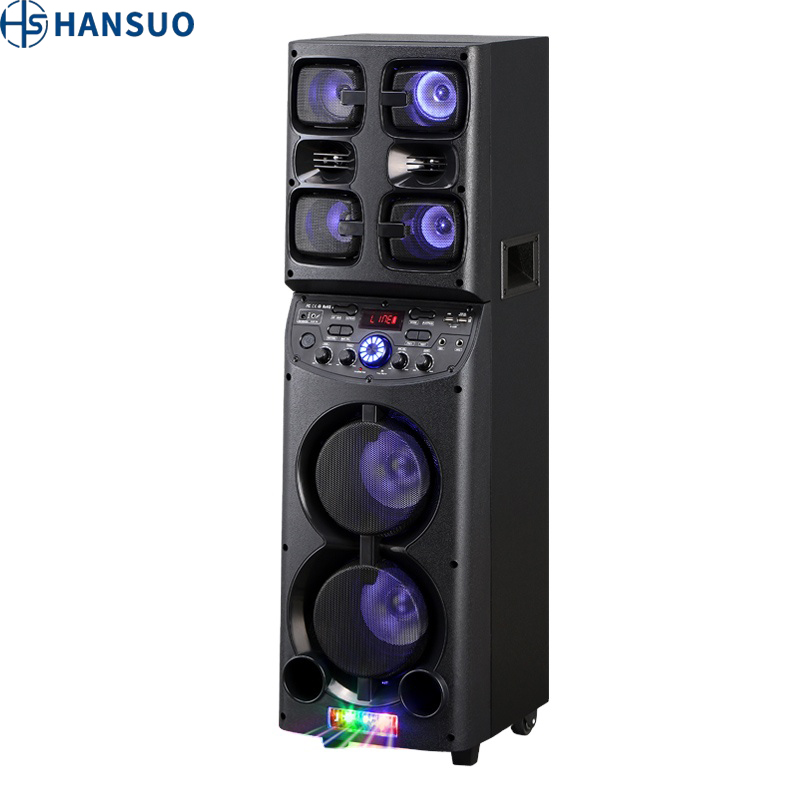
A Partybox can sound excellent and still fail the outdoor test if it is miserable to move. Weight distribution, handle design, and wheel quality matter as much as the driver. A 15 kg box is manageable for a short carry, but a 30 kg box on small wheels can be dangerous on stairs or gravel. Trolley outdoor speakers solve some of that problem, though they add weight and can rattle if the chassis is not braced. For mixed indoor and outdoor use, a 10 to 18 kg box with a sturdy top handle and optional wheel kit is often the sweet spot. The table below compares a portable Partybox with a fixed home speaker and a basic Bluetooth speaker.
| Factor | Portable Partybox | Fixed home speaker | Basic Bluetooth speaker |
|---|---|---|---|
| Typical weight | 8 to 20 kg | 5 to 30 kg per unit | 0.3 to 2 kg |
| Battery runtime | 6 to 12 hours | Requires wall power | 4 to 10 hours |
| Maximum output | 95 to 110 dB | 100 to 115 dB | 80 to 95 dB |
| Weather protection | IPX4 to IPX7 | Usually none | IPX0 to IPX4 |
| Stereo pairing | Common | Wired or wireless | Limited |
| Low bass extension | Moderate | Deep | Minimal |
The Engineering Behind Consistent Sound
A portable Partybox is only as good as the consistency of its production. A great prototype means little if later units drift in sensitivity, impedance, or bass tuning. During a batch validation for a European distributor, two production runs used the same driver model but different glue curing schedules. The faster-cured batch showed a Qts shift of roughly 0.1, enough to create a 2 to 3 dB difference in the lower bass. The issue was not the driver design. It was process control. That kind of variation rarely shows up in a single review, but it shows up in the field. Manufacturers that control incoming components, curing times, and final QC checks deliver a more predictable product. For buyers who need repeatable quality across orders, Hansuo in Guangzhou has built manufacturing depth around waterproof outdoor portable speakers, trolley outdoor speakers, and wireless audio systems, with supply chain and quality control practices that serve global customers.