
 EN
What Measurements Reveal Before the First Listen
A high-quality speaker does not reveal itself through a logo or a flashy spec sheet. The first clue shows up in how the manufacturer reports measurements. IEC 60268-5 sets out standard methods for acoustic measurement, including conditions for frequency response, impedance, and sensitivity. When a data sheet lists 20 Hz to 20 kHz with no tolerance window, that number means very little. A useful response curve includes a dB range, such as plus or minus 3 dB, and states the measurement axis and distance. Sensitivity deserves the same scrutiny. A claim of 95 dB can be measured at 1 kHz with a narrow band signal, while the average sensitivity across the vocal range may be several dB lower. Impedance is another quiet tell. A speaker rated at 4 ohms that dips to 2.5 ohms at low frequencies will demand more current from an amplifier, and cheap electronics may struggle. A few published curves and a clear measurement condition separate serious engineering from copywriting.
Cabinet Materials and the Physics of Vibration
The cabinet is not a neutral box. It stores and releases energy, and poor bracing lets panels flex in sympathy with the driver. MDF remains common because it is dense, uniform, and easy to machine. Plywood offers better strength-to-weight in some designs, though voids and inconsistencies can cause problems. The real differentiator is internal bracing and damping. A cabinet with cross braces and bitumen pads controls panel resonance, which keeps midrange detail from turning muddy. Port design also matters. A flared port reduces chuffing noise at high output, while a sharp-edged tube can produce audible turbulence. Sealed cabinets trade low-frequency extension for tighter transient behavior, which suits some rooms and not others. Buyers should treat cabinet thickness claims with caution. A 25 mm front baffle sounds impressive, but if the side panels are 12 mm and unbraced, the box may still ring. The goal is controlled resonance across the operating band.
Driver Choice and Crossover Execution
A speaker lives or dies by its drivers and the crossover that ties them together. Woofer size, cone material, spider compliance, and magnet strength all shape efficiency, bass extension, and distortion. A larger woofer can move more air, but it may struggle to reproduce midrange detail if the cone breaks up early. Tweeter design matters just as much. Soft dome, metal dome, and horn-loaded tweeters each have strengths and trade-offs. The crossover is where many budget speakers fail. A first-order crossover with cheap capacitors can leave a woofer running too high, causing beaming and uneven off-axis response. A well-executed fourth-order Linkwitz-Riley crossover costs more parts but produces cleaner driver integration. Phase alignment at the crossover point is easy to hear. When a singer's voice seems to split between two drivers, the crossover is likely the culprit. A near-field scan of each driver, followed by a summed response, shows whether the crossover region has a dip or a peak.
Power Ratings, Distortion, and Honest Efficiency
Power ratings are the most abused numbers in consumer audio. Peak power can describe a brief burst that lasts milliseconds, while RMS or continuous power describes what the speaker can handle over time. A 500 W peak rating may sit next to a 50 W RMS rating, and the smaller number is the one that matters for daily use. Distortion is the other half of the story. Total harmonic distortion, or THD, should be quoted at a meaningful sound pressure level. A 0.1 percent THD at 70 dB is not impressive if the speaker reaches 100 dB in real use with 5 percent distortion. The table below contrasts common marketing claims with engineering realities.
| Spec | Marketing claim | Engineering reality |
|---|---|---|
| Peak power | 500 W | Often a short burst, not continuous |
| Frequency response | 20 Hz to 20 kHz | Missing tolerance and measurement conditions |
| Sensitivity | 95 dB | Often measured at 1 kHz, not averaged |
| THD | Rarely shown | Critical at realistic listening levels |
| Cabinet | "Premium wood" | Density, bracing, and damping decide resonance |
| Impedance | 4 ohms | Minimum impedance may dip much lower |
Heat, Humidity, and Long-Term Durability
A speaker that sounds excellent on day one can degrade quickly if thermal and environmental factors are ignored. Voice coils heat up during playback, and rising temperature increases resistance, which can compress dynamics. Ferrofluid in tweeters helps with heat transfer, but it can dry out over time. Humidity is a slower threat. Paper cones may absorb moisture, and untreated steel baskets can rust. In an outdoor speaker, conformal coating on the circuit board and sealed port tubes can make the difference between a product that lasts several seasons and one that fails after a few rainy weekends. During a trial production run for a Southeast Asian client, two batches of outdoor Bluetooth speakers used the same driver model but different glue curing schedules. The faster-cured batch showed a Qts shift of roughly 0.1, enough to create a 2 to 3 dB difference in the lower bass. The issue was not the driver design. It was process control. That kind of variation rarely shows up in a single review, but it shows up in the field.
Listening Tests, Batch Consistency, and Supply Chain Discipline
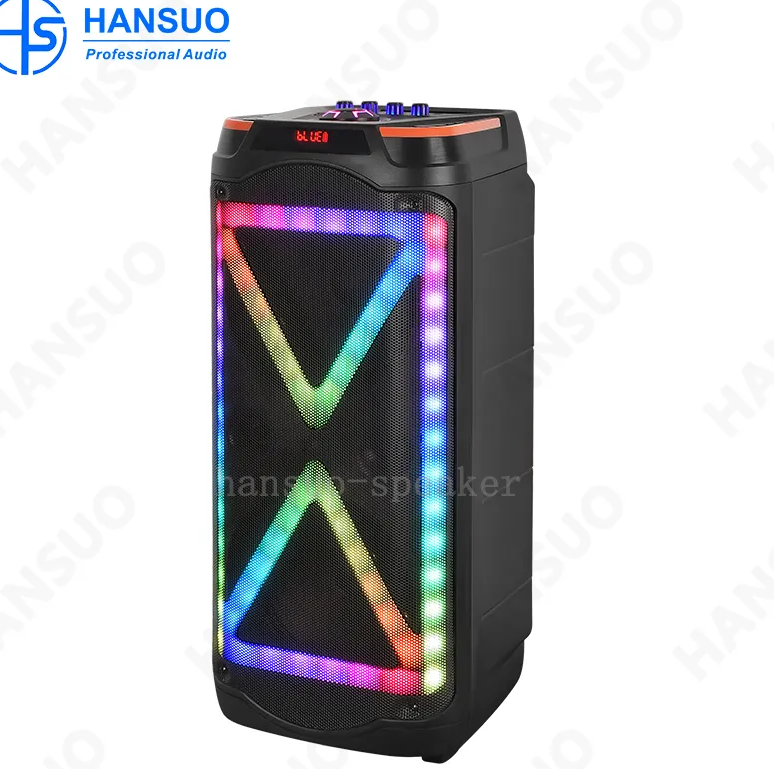
Measurements narrow the field, but listening tests decide the final call. Controlled blind tests, such as those used in AES studies on loudspeaker preference, show that listeners often favor smooth, consistent directivity over exaggerated detail. A speaker that sounds bright in a showroom may become fatiguing after an hour. A speaker with a gentle presence peak may sound dull at first but hold up over long sessions. Batch consistency is the final piece. A great prototype means little if production units drift in sensitivity, impedance, or bass tuning. Manufacturers that control incoming components, curing times, and final QC checks deliver a more predictable product. Hansuo in Guangzhou has built its manufacturing around waterproof outdoor portable speakers, trolley outdoor speakers, and wireless audio systems, with supply chain and quality control practices that support global buyers who need repeatable results across orders.