
 EN
EN
Lessons From a Party That Died Too Early
A couple of summers ago, a friend asked me to help with the sound for his backyard birthday party. He had bought a large speaker that looked powerful. Lots of flashing lights. Big woofers on the front. But two hours into the party, the music started sounding thin and harsh. People moved away from the dance area. By midnight, everyone was just sitting around talking. The party energy completely died. What went wrong? He had chosen a speaker that looked the part but could not maintain clean output at high volume for more than an hour. That experience stuck with me. Over the years, I have tested dozens of DJ style speakers for house parties, block parties, and even small outdoor events. The difference between a speaker that keeps people dancing and one that clears the floor comes down to a few critical factors.
Power Ratings Lie. Look for Continuous Output Instead.
Many speaker brands advertise peak power numbers. Five hundred watts. One thousand watts. Even two thousand watts on some cheap models. Those numbers are almost meaningless. Peak power is the maximum the speaker can handle for a fraction of a second before blowing up. What matters for a party speaker is continuous RMS power. That is the amount of power the speaker can sustain for hours without distorting or overheating. A speaker with 200 watts RMS will often sound louder and cleaner than a poorly built speaker claiming 1000 watts peak. A sound engineer once explained to me that many consumer brands inflate peak numbers because they know shoppers get impressed by big digits. For a party atmosphere where you need high energy for four or five hours straight, look for a speaker that clearly lists RMS power. Also check if the amplifier is built into the speaker or external. Built in amplifiers designed properly have better heat management. A manufacturer with real engineering experience, like Hansuo which holds 26 patents, understands that reliable RMS ratings matter more than fake peak numbers.
Coverage and Dispersion Keep the Whole Room Moving
Another common mistake is buying a speaker that shoots sound in only one direction. Most basic PA speakers have a narrow dispersion pattern. That means the sound is loud and clear only if you stand directly in front. Move to the side, and the volume drops dramatically. For a party, you want everyone to feel the energy, not just the people in the sweet spot. Look for speakers with a wide dispersion angle, 90 degrees horizontal or more. Some DJ speakers also feature horn loaded tweeters that spread highs more evenly across a room. I remember helping a friend set up for a graduation party in a long, narrow garage. We used two speakers with wide dispersion placed at opposite ends. The result was consistent energy from the front door to the back wall. No dead zones. No one had to shout over the music to have a conversation. That is the kind of coverage that keeps a party feeling alive.
Bass That Moves Bodies Without Distorting
Party music lives on bass. Kick drums, bass drops, and low synth lines are what make people want to move. But not all bass is created equal. A cheap party speaker will have a single woofer that tries to do everything. The result is muddy, boomy bass that lacks punch. For real energy, look for a speaker with a dedicated subwoofer or at least a large woofer paired with a passive radiator. The passive radiator design gives you tighter, more controlled low end. During a block party last year, a DJ friend of mine used a pair of speakers from a Guangzhou based manufacturer. The bass was so clean and punchy that people could feel it in their chests, but it did not distort at high volume. That manufacturer told me they spent months tuning the crossover and the passive radiator to avoid the flabby bass common in party speakers. If you want a speaker that can handle hip hop, electronic, or reggaeton without falling apart, pay attention to the woofer size and the bass loading design. Eight inch woofers are okay for small rooms. Ten or twelve inches are better for real parties.
Durability for Long Nights and Repeated Use
A DJ speaker for parties gets abused. It gets moved around, bumped into tables, and played at high volume for hours. Many consumer speakers are not built for that kind of treatment. Overheating is a common issue. After an hour or two at high volume, the amplifier’s thermal protection kicks in and the volume drops automatically. That kills a party fast. Look for speakers with metal grilles instead of cloth, reinforced corners, and proper heat sinks or cooling fans. Also check if the brand mentions continuous duty cycle testing. A reliable manufacturer will test their speakers at full power for 24 hours or more. Someone in the audio industry once told me that the difference between a party speaker and a professional speaker is often just the thermal design. Companies that export to hot climates like the Middle East or Africa have to build speakers that handle heat. Hansuo, for example, exports to nearly 30 countries including regions with extreme temperatures. That kind of real world testing forces better durability.
Portability and Setup Matter More Than You Think
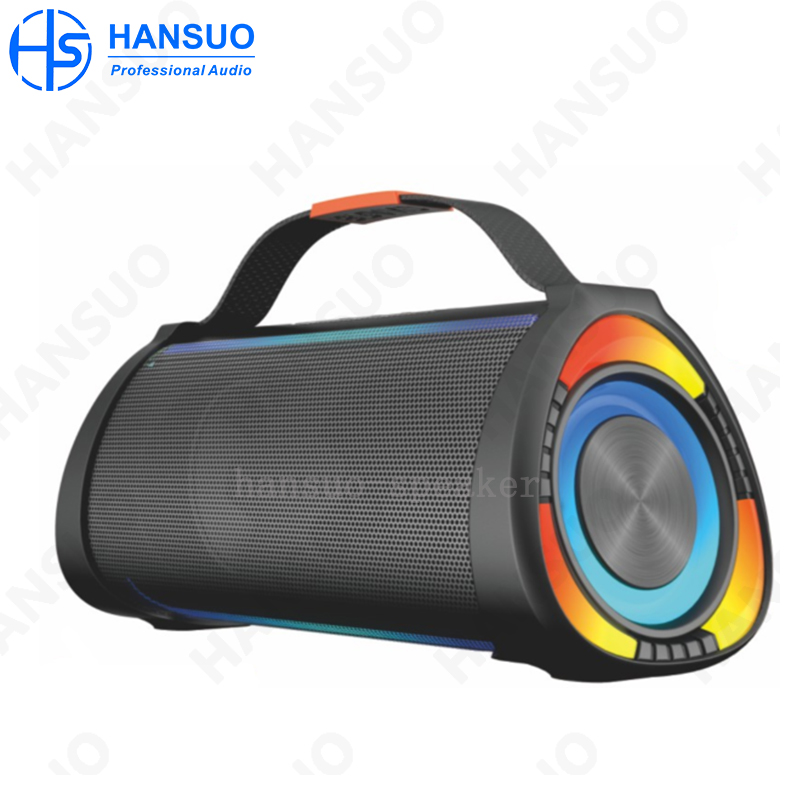
No one wants to spend an hour setting up speakers before a party. And no one wants to carry heavy, awkward gear up a flight of stairs. A good party speaker should have handles that are comfortable to grip, wheels if it is large, and a weight that one person can manage. I once borrowed a massive speaker for a rooftop party. It sounded incredible, but it took three people to carry it up four floors. After the party, no one wanted to help bring it down. It sat on the roof for two days. That was a hassle. For most parties, a speaker with a built in rechargeable battery is a game changer. No extension cords, no searching for power outlets. Many of Hansuo’s battery powered speakers are designed for exactly this kind of use. Also look for Bluetooth connectivity with enough range so you can keep your phone near the DJ area without dropouts. Some speakers also offer daisy chaining, which lets you connect two or more units together for even more coverage and volume.
Why Professional Manufacturing Delivers Better Parties
After watching countless parties succeed or fail based on the sound system, a clear pattern has emerged. The speakers that keep people dancing all night come from manufacturers who understand real world use, not just lab specs. A company that holds certifications like CE, RoHS, BSCI, ISO9001, and ISO45001 has proven that they care about quality and safety. Those certifications mean regular audits and strict testing. For a party speaker, that translates to reliable performance when you need it most. Hansuo, with over nine years of experience and a factory spanning 3000 square meters, builds multimedia speakers, portable speakers, and battery powered speakers for clients across nearly 30 countries. Their annual export volume reached 5 million US dollars in 2024. That scale matters because it means their products have been tested in thousands of real parties, events, and gatherings around the world. Choosing a speaker from that kind of manufacturing background gives you confidence that when the bass drops at midnight, the music will keep playing until the last guest leaves.
Table of Contents
- Lessons From a Party That Died Too Early
- Power Ratings Lie. Look for Continuous Output Instead.
- Coverage and Dispersion Keep the Whole Room Moving
- Bass That Moves Bodies Without Distorting
- Durability for Long Nights and Repeated Use
- Portability and Setup Matter More Than You Think
- Why Professional Manufacturing Delivers Better Parties